
And the Glory:
Coming Home to Weaverville’s Messiah
Messiah 2026: A Weaverville Tradition Since 1948
Forty-four years after I first sang it as a freshman tenor, I’m honored to conduct Handel’s Messiah again for a Weaverville tradition that began in 1948. Come sing with us or come listen.
In 1982, a short ninth grader from North Buncombe High School stood in a room full of seasoned adul singers and thought, simply, WOW. That was me. I was singing tenor, my high school choral director was at the organ, and on the podium stood the woman who started it all, who also happened to be my piano and voice teacher: Mrs. Irene Clark.
This December, I’ll raise my hands in front of that same tradition again, this time as its conductor. I can’t think of a greater honor.
The teacher who never gave up on me
I first met Mrs. Clark in seventh grade, when she came to my elementary school to help us put on a little musical. Afterward, she offered my parents and me voice and piano lessons, and I began studying with her in eighth grade.
I’d love to tell you I was a model student. I wasn’t. I rarely practiced, and I’m still surprised she never
“fired” me.
But I loved to sing and play, and Mrs. Clark met my lack of practice, and more than a little precociousness, with grace and love. She was so kind to my family and to me. Looking back, her patience may have been the most important lesson she ever taught me.
The night she conducted with one arm
That first year gave me a memory I’ve never forgotten. On the day of the performance, Mrs. Clark fell after the morning worship service at the Methodist church and fractured her arm. That evening, with her arm in a cast, she conducted Messiah anyway, without missing a beat.
Bob Terrell, the well-known Asheville Citizen-Times writer, told the story of Weaverville’s “One Armed Choir Director.” All of us were amazed by her stamina and artistry under such difficult circumstances.
About twenty years later, early in my own conducting career, that lesson came back to me. I was conducting Asheville Lyric Opera’s production of Amahl and the Night Visitors when I broke my right arm playing indoor soccer. The very next night was the dress rehearsal, and I had to figure out how to
become a left-handed conductor overnight. My thought was simple: Mrs. Clark had done it before, so Icould do it now.
How a Weaverville tradition began
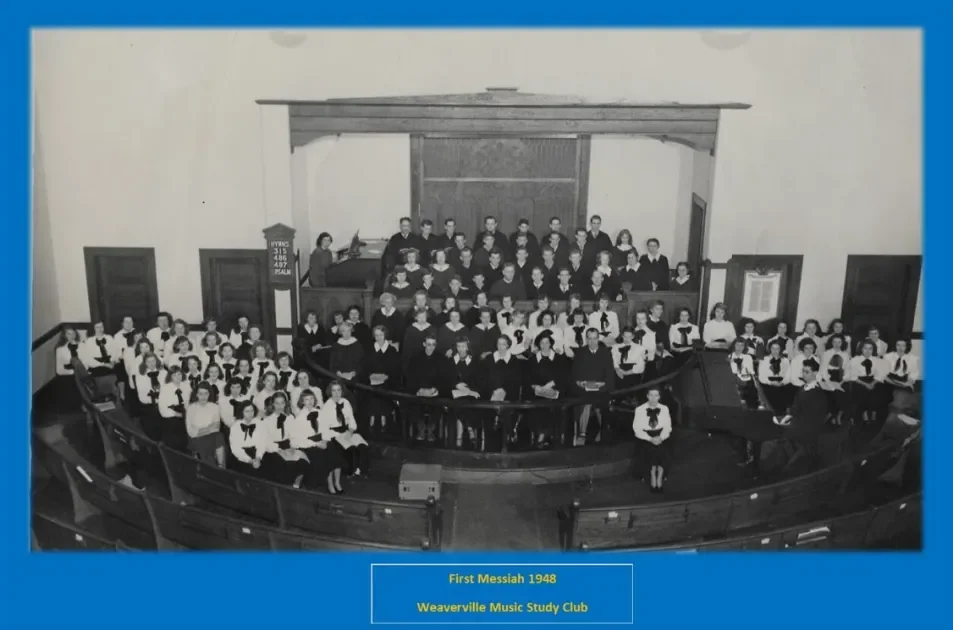
The Weaverville Music Study Club was formed in 1941 to promote a love of good music in our town. In the fall of 1948, club president Mrs. Grover Brown proposed something ambitious: a community performance of Messiah.
She turned to Irene Holcombe Clark, a Berea College music graduate who was teaching music at Weaverville High School. Mrs. Clark knew the music from her college days and accepted the challenge of teaching it to her students. Buncombe County Schools superintendent R. A. Tomberlin even allowed two teachers to leave their classrooms to help.
Singers from area church choirs soon joined the students, and 123 people took part in the first performance on December 15, 1948, at the Weaverville Methodist Church.
Mrs. Clark directed every year from 1948 until 1994, alternating the Christmas portion one year with the Easter portion the next. Some singers stayed for a lifetime: Rev. Wendell Brittain sang in that very first performance and took part in 35 of the first 47 Weaverville performances, singing his last in 2016. Today the club is led by Mrs. Clark’s niece, Harriet Holcombe Burnette, and Messiah is presented every other year.
From the choir to the podium
Years later, I had the privilege of conducting the Weaverville Messiah for the first time, and I dedicated that performance to Mrs. Clark’s memory. I returned to the podium in 2022 and 2024, and I’m honored to lead it again this year.
I’ve sung, played, and conducted Messiah more times than I can count. But this one, in this town, with this history, will always feel like coming home.
This year’s Messiah
This year’s performance draws mostly from Part I, the Christmas portion, with several selections from Part II woven in. Two things shaped those choices. I wanted to give our tenor another chance to shine, and I have been troubled by the war and destruction around our world.
Near the end of Part II, Charles Jennens, who compiled Messiah’s text from Scripture, placed a ancient question from Psalm 2: “Why do the nations so furiously rage together?” It feels as urgent today as it did in 1741. In our program, the answer comes in music rather than argument: “Lift up your heads” then words of rejoicing and comfort, and at last the Hallelujah Chorus.
This will also be my first time making music with tenor Casey Edwards, and I’m bringing some new ideas about tempo and interpretation to rehearsals. Even after all these years, Messiah keeps teaching me something new.
Our soloists and organist
Our soloists are among the finest professional singers in Western North Carolina.
Amanda Horton, soprano, holds opera performance degrees from Furman University and Shenandoah Conservatory and was a Young Artist with Opera Santa Barbara. She has sung Messiah with the Long Bay Symphony and Mozart’s Requiem with the Asheville Symphony, and Classical Voice of North Carolina called her Maria in Asheville Lyric Opera’s The Sound of Music “magnificent.”
Rachel Hansbury, alto, teaches voice at UNC Asheville and has appeared as a soloist with the Asheville Choral Society, Gateway Chamber Orchestra, and Music City Baroque. A Nashville reviewer called her performance “the highlight of the night.” She has studied with and taken masterclasses from artists including Judy Collins, the King’s Singers, and Meredith Monk.
Casey Edwards, tenor, discovered singing at 19 while studying trumpet. He went on to earn a bachelor’s degree in vocal music from the University of Southern Mississippi and a master’s in vocal performance from Texas Tech University, and he serves as tenor section leader at First Presbyterian Church of Asheville.
Jonathan Ross, bass, earned music degrees from James Madison University and Binghamton University and was a resident artist with Tri-Cities Opera. With Asheville Lyric Opera he has sung Papageno, Figaro, and Leporello, and he has appeared as a soloist with the Asheville Symphony.

Jonathan Ross, bass, earned music degrees from James Madison University and Binghamton University and was a resident artist with Tri-Cities Opera. With Asheville Lyric Opera he has sung Papageno, Figaro, and Leporello, and he has appeared as a soloist with the Asheville Symphony.
At the organ is Eric Fricke, who appeared on public radio’s From the Top as a teenager, studied with
virtuoso organist Cameron Carpenter and served as principal organist at the Cathedral Basilica of St. Francis of Assisi in Santa Fe. Eric is technically superb, an incredible improviser, and he simply “music.” In rehearsal he listens right along with me, often noticing that a section needs more support before I can say a word. Western North Carolina is lucky to have him, and we make a great team.
A few things you may not know about Messiah
It was written in about 24 days. Handel began on August 22, 1741, and finished the score on September 14.
It premiered in the spring, as a charity concert. Messiah was first heard in Dublin on April 13, 1742, shortly after Easter. To squeeze in more listeners, ladies were asked to leave the hoops out of their skirts and gentlemen to leave their swords at home. About 700 people crowded into a hall Handel thought held 600, and the proceeds helped free more than 140 people from debtors” prison.
Two of our choruses began as Italian duets. “For unto us a child is born” and “His yoke is easy” both reuse music Handel had written months earlier for two sopranos, set to secular Italian poems. “His yoke is easy” began as a poem about a flower that smiles at dawn and fades by evening.
Handel wanted the angels” trumpets far away. In “Glory to God,” he marked the trumpets to play softly and from a distance.
The King George story is probably a legend. Tradition says King George II stood during the “Hallelujah” chorus, and everyone followed. But there is no contemporary evidence he was even there, and the story first appears in a letter written 37 years later. (Stand anyway. We love it.)
Messiah came to America in a New York tavern. Its first performance here, in January 1770, was a benefit concert a bankrupt former Trinity Church employee organized for himself. Like ours, it was a selection: the overture and sixteen numbers.
Handel used Messiah to care for children. He gave annual benefit performances for London’s Foundling Hospital, a home for abandoned children, and left it a copy of the score and parts so the concerts could continue. Our offering for the Music Study Club’s scholarship fund carries that same spirit.
The moment that makes it all worth it
There’s a moment I wait for every time. After the Overture and the tenor’s “Comfort ye” and “Every
valley,” I raise my hands to begin “And the glory of the Lord.” I look up and see all those eyes, eager, some a little fearful but willing, ready to bring this music into being. So much potential, waiting to be realized.
And then it happens. First the altos, then the rest of the parts, and so it goes for the next hour or so. When we release the last chord of the Hallelujah Chorus and the audience erupts, I get to see the singers” faces, full of accomplishment and utter joy. That makes everything, EVERYTHING, worth it.
For me, this music carries deep spiritual meaning. For others, it is simply some of the most achingly beautiful music ever written. Both are welcome here, and no faith expression is required, only a love of singing or listening.
Come sing with us, or come listen
We expect more than 50 singers this year, and we’d love to reach 70. I’m looking forward to seeing some familiar faces, including a couple of old high school classmates, and to meeting singers who are brand new to Messiah. Professional musicians and first-time singers will stand side by side, as they have in Weaverville since 1948.
To sing
Free to join. No audition and no experience required. All ages and voice parts are welcome.
Rehearsals: Sundays, November 1, 8, 15, 22, and 29, from 3:00 to 4:30 PM
Location: First Baptist Church Weaverville, 63 N. Main Street, Weaverville
Music is provided, and vocal part recordings are available.
To register, email Harriet Burnette at dlbhburnette@gmail.com with your name, voice part, phone number, and email address. Questions? Call 828-778-5510.
To listen
Sunday, December 6, 2026, at 4:00 PM | First Baptist Church Weaverville, 63 N. Main Street
Free admission, with an offering for the Weaverville Music Study Club’s Music Scholarship Fund, A delicious reception follows the performance.
Seventy-eight years ago, Mrs. Clark said yes to a challenge and gave our town a song. I hope you’ll help us sing it again.